
You’ve been here before. You promise never again, delete your browser history, and pray for forgiveness.
But a week later—after a stressful day or a lonely night—the cycle repeats.
You hate it. You feel guilty and weak. Even dirty. Ultimately stuck.
Why do I keep going back? What’s wrong with me?
Is your lust just too strong? Do you lack the willpower to experience victory? Or is something deeper driving you?
Beyond Willpower: Coping with Pain, Not Just Chasing Pleasure
From the outside, it looks like an addiction to lust.
From the inside, it feels like a magnetic pull you can’t resist.
What if I told you that porn isn’t just about craving pleasure? It’s about managing pain.
Neuroscience shows that pornography can numb stress and trigger dopamine releases in the same way addictive substances do, hijacking the brain’s reward system and offering temporary relief.
In other words, porn often becomes a functional savior—a quick fix when life feels too much.
But here’s the bigger picture: at the core of every sin is a story of self-protection.
It started in the garden.
Adam and Eve felt shame and fear, so they hid. Covered themselves. Tried to manage their pain. And God came walking toward them saying, “Where are you?”
That’s still the story of man today.
We feel anxious, unseen, or unsuccessful—and instead of trusting God’s goodness, we grab for fig leaves of our own.
Porn just happens to be one of the more powerful ones.
So while viewing porn is horrific, your struggle isn’t proof that you’re especially perverse.
It’s proof that you’re human. That you carry pain. That you’ve learned to self-soothe instead of receive love.
The Emotional Logic Behind Porn
Studies show people who feel lonely or emotionally dysregulated are far more likely to use porn. Loneliness activates anxiety. Anxiety looks for relief. Porn gives a quick hit of what feels like connection and closeness, only without any risk.
So it’s not just about temptation—it’s about disconnection.
When your body is flooded with stress hormones, your brain doesn’t say, “Let’s remember the gospel.” It says, “Let’s survive.”
That’s how habits form.
That’s how neurons get wired to reach for screens instead of Jesus.
Why? Because sin causes all of us to try and solve shame on our own.
But here’s the good news:
Jesus doesn’t just forgive the behavior; He rewrites the story. He rewires the brain.
Jesus meets you in that moment of panic—not with disgust, but with compassion.
“Come to me, all who are weary,” He says in Matthew 11:28.
Yes—even the ones still tempted.
Attachment Wounds: Why We Run to Fantasy
Underneath porn use is often an attachment wound—a painful gap between the love we needed and the love we experienced.
Maybe you grew up unseen. Or felt like affection had to be earned. Maybe you learned early that vulnerability wasn’t safe.
Now, as an adult, you crave intimacy but fear rejection. Whether you realize it or not, porn becomes the perfect counterfeit: closeness without risk.
Therapists call this insecure attachment. The Bible calls it fear. And perfect love drives out fear (1Jn 4:18).
But when being close to people hasn’t felt safe, your nervous system doesn’t believe that verse. It believes: “I’m safer when I’m in control.” That’s why porn is so magnetic—it lets you feel desired and in charge. No rejection. No exposure.
And yet, it’s counterfeit intimacy.
It numbs the ache but never fills it.
Like drinking salt water—it soothes the thirst for a moment but deepens the dehydration underneath.

When Jesus Meets Your Porn Use
When you start to see porn as self-protection, not just rebellion, something shifts.
The good news that Jesus brings is the revelation that:
- You were created for secure love.
- Sin taught you to distrust it.
- He came to restore it.
Jesus doesn’t just demand purity; He offers presence.
He’s not waiting at the finish line of your recovery—He’s standing in the mess right now, gently saying, “You don’t have to hide. I already know, yet I’m still here.” (1Pet. 5:7)
The cross isn’t only where your guilt is paid for, it’s where your shame is met with compassion. Where your defensive parts finally find someone safe enough to rest.
A Better Way Forward
If porn has become your medicine, the answer isn’t just to throw away the pills. It’s to heal what the medicine was masking.
That means:
- Facing your pain with honesty, not hiding.
- Learning to soothe with connection, not control.
- Letting Jesus shepherd the parts of you that feel lost and unlovable.
Healing doesn’t start with “try harder.” It starts with “be honest.”
Because honesty cracks open the door for true, perfect love to enter.
A Simple Practice: The “Where Are You?” Pause
Next time you feel the pull:
- Pause – Put a hand on your chest. Breathe.
- Ask – “What am I feeling right now?” (Lonely? Angry? Afraid? Tired?)
- Listen – “What is this part of me trying to protect?”
- Respond – Whisper: “Jesus, here’s where I am.”
Wait.
Let Him come find you.
That’s not weakness. That’s worship.
Final Thoughts
Your use of porn isn’t just a moral collapse—it’s a mirror. It reflects where your heart still aches to believe God’s love is real.
And the good news?
That love is real.
It’s patient enough to sit with your shame. Gentle enough to touch your wounds. Strong enough to retrain your brain.
You don’t need to fix yourself before coming to Him. You need to come to Him so you can finally stop trying to fix yourself.
Because this isn’t just about breaking habits. It’s about becoming whole.
Does this resonate with you? If so, type “Yes” in the comments below.
Coming Up in Part 2
In the next part, we’ll look inside that inner conflict—the one where part of you wants to change and another part sabotages it.
You’ll see how those parts aren’t enemies to be silenced, but rather younger selves to be understood. And you’ll see how Jesus doesn’t shame them—He sits with them.
Because freedom doesn’t come from fighting harder.
It comes from being loved deeper.
I wish I had learned this years ago: a way to finally hear what my heart is actually saying underneath the struggle. You won’t want to miss it. Subscribe below to have it delivered directly to your inbox:
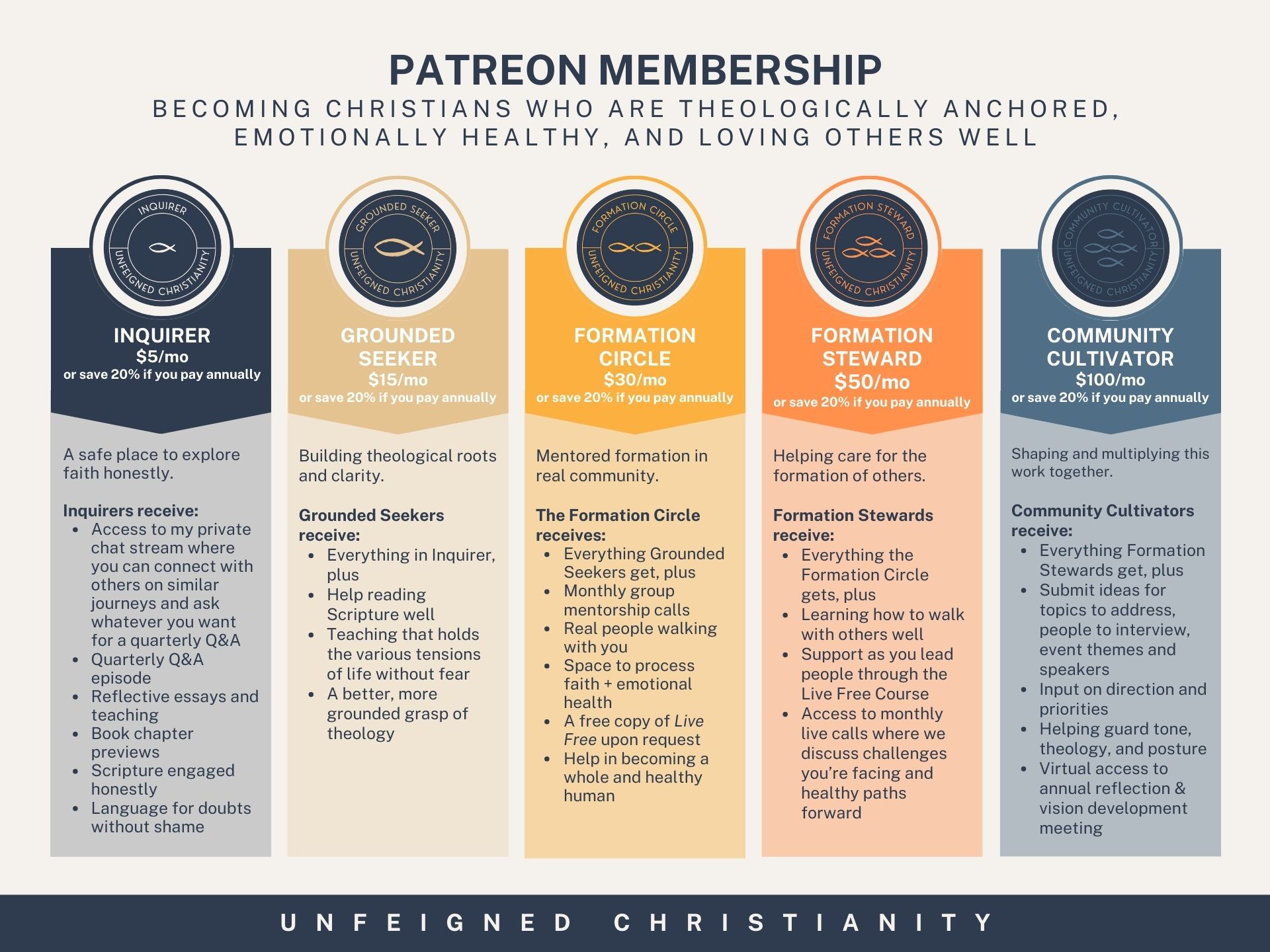
Join Unfeigned Christianity on Patreon and Take Your Journey to the Next Level.
Become a paying member of Unfeigned Christianity for as little as $5/mo and access article, our community chat stream, and quarterly Q&A episodes.
Already a member? Login